RACHEL GROSSMAN-KAHN
ACCESSIBILITY DESIGN LEADER
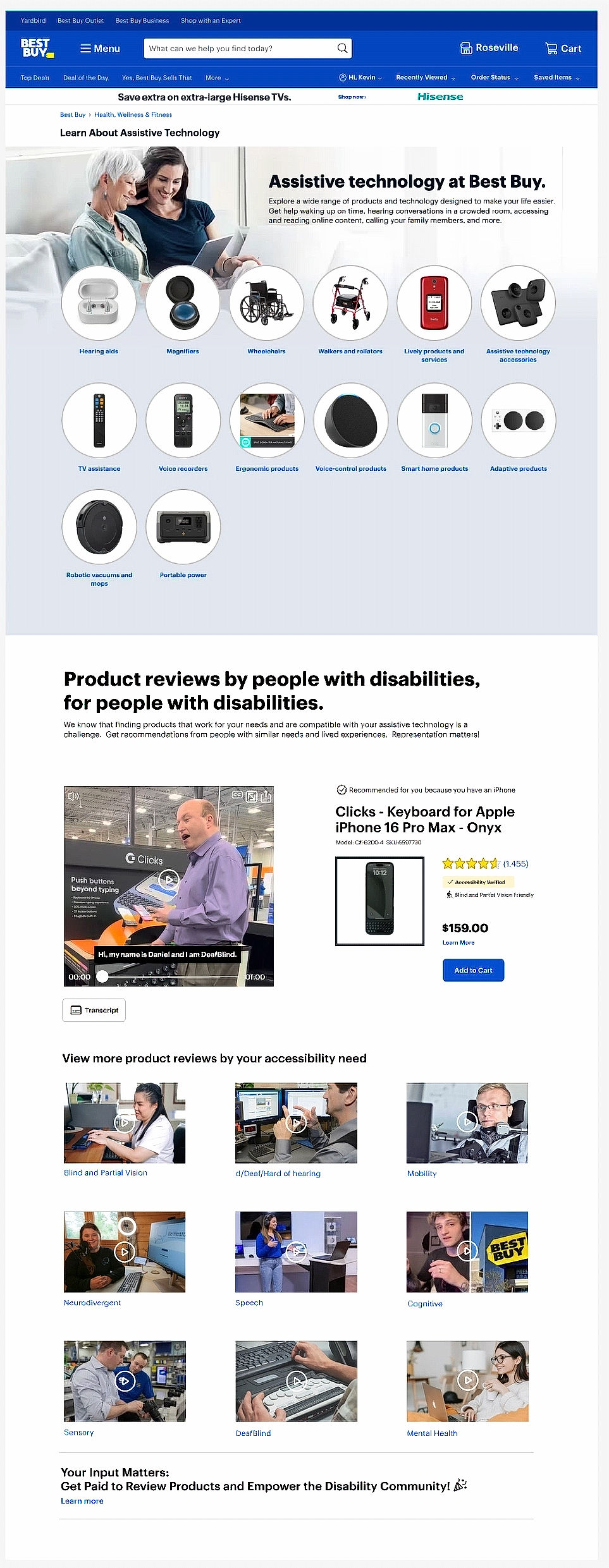
Assistive Technology Category
A dedicated hub on BestBuy.com and the mobile app, offering a centralized shopping experience designed specifically for customers with disabilities and their families.
Client: Best Buy
Role: Project Manager & UX Designer
Awards: Growth Through Inclusivity Award 2025, Best in Show 2023,
Customer Obsessed 2023
Press: Landing Page Announcement
Link: Assistive Technology Page

DESIGN CHALLENGE
It begins with a haunting story...
A Blind customer told us she'd purchased and returned printers seven times—taking each one home and paying someone to set it up, only to find it was incompatible with her screen reader. She never found a printer that worked.
That story stuck with me. It wasn’t just about one customer—it reflected a broader truth: people with disabilities were left to navigate tech shopping alone, without trust, guidance, or representation.
At Best Buy, there was no way to browse by accessibility features, no product information designed for her needs, and no clear path to learn what worked for someone like her. We had thousands of assistive technology products across our site, but they were buried, disconnected, and nearly impossible to find.
It was time to change that.
SOLUTION
We launched a dedicated Assistive Technology category and landing page under Health & Wellness, making inclusive tech easier to find, explore, and trust. I led the UX strategy to support both product-type and disability-specific browsing, creating multiple entry points based on how users actually shop.
In 2025, I expanded the experience with a prototype for accessibility reviews — real product feedback from disabled users, filtered by disability type. This user-generated content centers lived experience, builds confidence, and reflects our belief that inclusive design is strongest when it’s co-created.
PROCESS
I pitched my ideas for an inclusive shopping experience and with a combination of our ideas and support from my director, Vidhya Subramanian, I assembled a cross-functional team of 11 — researchers, designers, engineers, and QA — united by a shared commitment to accessibility. We called ourselves The Accessinators. While not all teammates had prior experience in accessibility, everyone brought curiosity, care, and a desire to make Best Buy more inclusive.
RESEARCH
TLDR
To better serve the 27% of Americans with disabilities, we redesigned how Best Buy presents and curates assistive technology — transforming a fragmented, search-only experience into a welcoming, browsable destination. I led the UX and design strategy for a dedicated Assistive Technology category and landing page, featuring curated product collections by disability type and, later, accessibility reviews created by disabled users themselves.
This work not only expanded our reach to an underserved and powerful customer base with over $1 trillion in disposable income, but also demonstrated Best Buy’s deepened commitment to inclusion. Our solution empowered customers to shop with confidence, discover life-enhancing technology, and see themselves reflected in the product experience.
Launched on Global Accessibility Awareness Day 2023 and developed further in 2025, this award-winning work became a model of designing with the disability community — not just for them. Within 6 months, our conversion rate on this page quadrupled Best Buy's average.


To better understand how customers shop for assistive technology and validate our approach, we focused our research on three core questions:
-
How do customers mentally organize accessibility products?
-
How do competitors present and categorize them?
-
What language resonates best with the disability community?
Card sorting revealed the need for multiple browsing paths—by disability and by product type—to align with diverse mental models. Our competitive analysis showed gaps in search functionality (e.g., Target) and highlighted strong filtering UX from companies like Airbnb.
We also partnered with a DeafBlind consultant to gain lived-experience insights. Through interviews and an in-store product review video, we learned how he evaluates tech before purchasing. We selected the Clicks keyboard case for iPhone for his review—a lesser-known product that significantly enhances communication. This reinforced our goal: to surface meaningful, user-loved assistive tech that might otherwise go unnoticed.
DESIGN


With research validating both the innovation and need, we moved into design—my favorite part of the process! I began by redefining the information architecture to support two clear paths: traditional product categories and new disability-specific collections, based on our card sort findings. I then created user flows and wireframes, including filters by disability type, and collaborated cross-functionally to gather existing design assets for consistency and efficiency.
My colleague Kevin Klos and I drove the UX—crafting the IA, defining categories, naming conventions, selecting product imagery, and writing inclusive content. Because our goal was to create a welcoming, centralized hub for customers with disabilities, we included helpful links like our accessibility statement and a feedback survey to further engage this community.
For the accessibility reviews feature, I designed a system to integrate them both into the current review feature on product pages and our accessibility hub, allowing customers to explore new tech by disability type. Reviews are delivered in multiple formats—video, captions, transcripts—to ensure broad access. We also tagged reviews with compatible disabilities and an “Accessible” badge, while noting that more work is needed to define accessibility standards across diverse needs, as what is "accessible" to one person with a disability might not be accessible to someone else, even with the same disability.
Throughout the design process, we made small but meaningful refinements: restructuring disability categories into a grid with icons for quick scanning, and simplifying CTAs to improve focus and usability. We also updated terminology based on community input—for example, using “partially sighted” instead of “low vision” or “visually impaired”—to ensure the language reflects respect and inclusion.
IMPLEMENTATION


Working in Agile, our engineering team began developing a prototype alongside our designs. To support development, we created detailed accessibility annotations in Figma—covering reading order, screen reader labels, states, and roles—and we even shared our template with the Figma community. One major challenge was tagging products by disability to enable filtering. Our initial solution—adding this to vendor spec sheets—proved unscalable and unenforceable. We revisited this problem in 2025 and pivoted: accessibility reviews from the disability community would “certify” products instead. This approach not only improved accuracy but reflected a deeper understanding I’ve gained—true inclusion comes from designing with people with disabilities, not for them.
Taking this project from concept to a live solution on BestBuy.com and our app was both challenging and deeply rewarding. Navigating the complexity of getting buy-in and cross-functional alignment taught me how to lead with empathy, influence without authority, and inspire others around a shared vision. I developed critical leadership skills—learning how to advocate effectively for customers who are often excluded from mainstream shopping experiences.
The product officially launched on Global Accessibility Awareness Day in 2023, opening a new, inclusive pathway for millions of customers. By organizing assistive technology into browsable, disability-specific collections and creating space for accessibility reviews by people with lived experience, we removed major friction points.
The impact has been significant as it’s helping Best Buy tap into a $1.2 trillion disability market. In the first six months after release the conversation rate was 4.07%, quadruple Best Buy's average across the site. The project was recognized with Best Buy’s Innovation Award in 2023 and again in 2025 when we added Accessibility Reviews—winning first place out of over 100 submissions both years. These honors reflect the power of inclusive design when you have a great team, great tools and a great company.
FINAL PRODUCT